
I was a seasoned CFO.
Which meant, before we ever bought our first home, I’d already mapped every expense, debt, and goal. For years I spent time sitting with my aunt, a forensic mortgage accountant, digging inside mortgage records to see what they actually looked like after closing. I learned to understand the incentive structure, to pay attention to who got paid and when, and I got very good at discovering what the documents concealed.
Yet, when I saw a monthly payment that fit our budget, I felt reassured that we were making the right decision. Everything seemed to add up. The numbers worked, the process felt thorough, and even with everything I knew, it was surprisingly easy to trust that we’d covered all the bases.
That’s how well-designed the system is. Understanding it doesn’t make you immune. It just means that afterward, you know exactly what happened.
The process is built to feel complete long before the picture actually is.
I wasn’t evaluating the decision anymore, I was being guided toward a conclusion. And I had more information than almost anyone who walks into that room.
If it can happen to me, it can happen to you.
How I Learned What the Documents Actually Show

My aunt spent forty years as a forensic mortgage accountant. I worked with her for twenty of those years, as a partner and adviser while still holding a demanding CFO position.
My nights, weekends, and the hours in between were spent sitting with the actual case files, learning firsthand what the mortgage system looks like from the inside when things go wrong.
Forensic mortgage accounting isn’t general financial advice. It’s the work of examining what actually happened to a loan after closing. The money trail, title transfers, servicing records, and escrow disbursements. Even whether each company involved actually has the legal right to collect payments or enforce the loan.
Together we found the difference between what the documents say versus what they actually show.
One case in particular stayed with me because of how unfair it was.
A homeowner of fifteen years attempted to refinance and discovered that three of the seven times her mortgage had been transferred, the assignments were never properly recorded. The chain of title was broken, which meant her refinance couldn’t proceed until the title issues were resolved. The process took months and cost thousands she hadn’t budgeted for.
She’d made every payment on time for fifteen years, unaware that mistakes were being made behind the scenes. She had no way of knowing there was a problem until she tried to refinance, and by then, she was left to deal with the consequences.
My aunt called it a textbook case. Not because it was unusual but because she’d seen it so many times it had become the pattern rather than the exception.
A second case, from before the 2008 crisis changed the rules. A woman with strong credit and stable income qualified for a conventional fixed-rate mortgage. She ended up with a subprime loan that had a higher rate, tighter margins, and a prepayment penalty buried in the closing documents that nobody walked her through. When her circumstances tightened, as life tends to do, she tried to refinance. The penalty made it too expensive to get out of and she was trapped.
The payment worked. The structure didn’t.
In both cases, nobody lied. The system simply worked as designed.
The Payment Isn’t a Neutral Number
Affordability isn’t fixed. It’s a function of how a loan is structured. Change the rate, the term, or the loan type, and a home can look comfortably within reach, slightly aggressive, or completely out of range without anything about the home itself changing.
That should tell you something important about what you’re actually evaluating.
A lender’s job is to find a structure that produces an approval within your income to debt ratios. A skill they are exceptional at. What they’re not designed to do, and please note this isn’t an accusation, it's simply how the incentives work, is to explain how that loan could affect your finances and your life in the years ahead. Everyone involved in the loan gets paid when you sign the deal. Their compensation isn’t tied to whether that mortgage turns out to be the right decision for you five years down the road.
The system is built to answer one question: can this be approved?
It’s not designed to answer the question that matters just as much: is this actually right for me?
The $134 That Wasn’t What It Appeared to Be
A friend called me recently. He’d found a home he loved, a monthly payment that worked for him, and a lender he liked. He used the word friendly to describe the lender and he genuinely believed he was getting good advice.
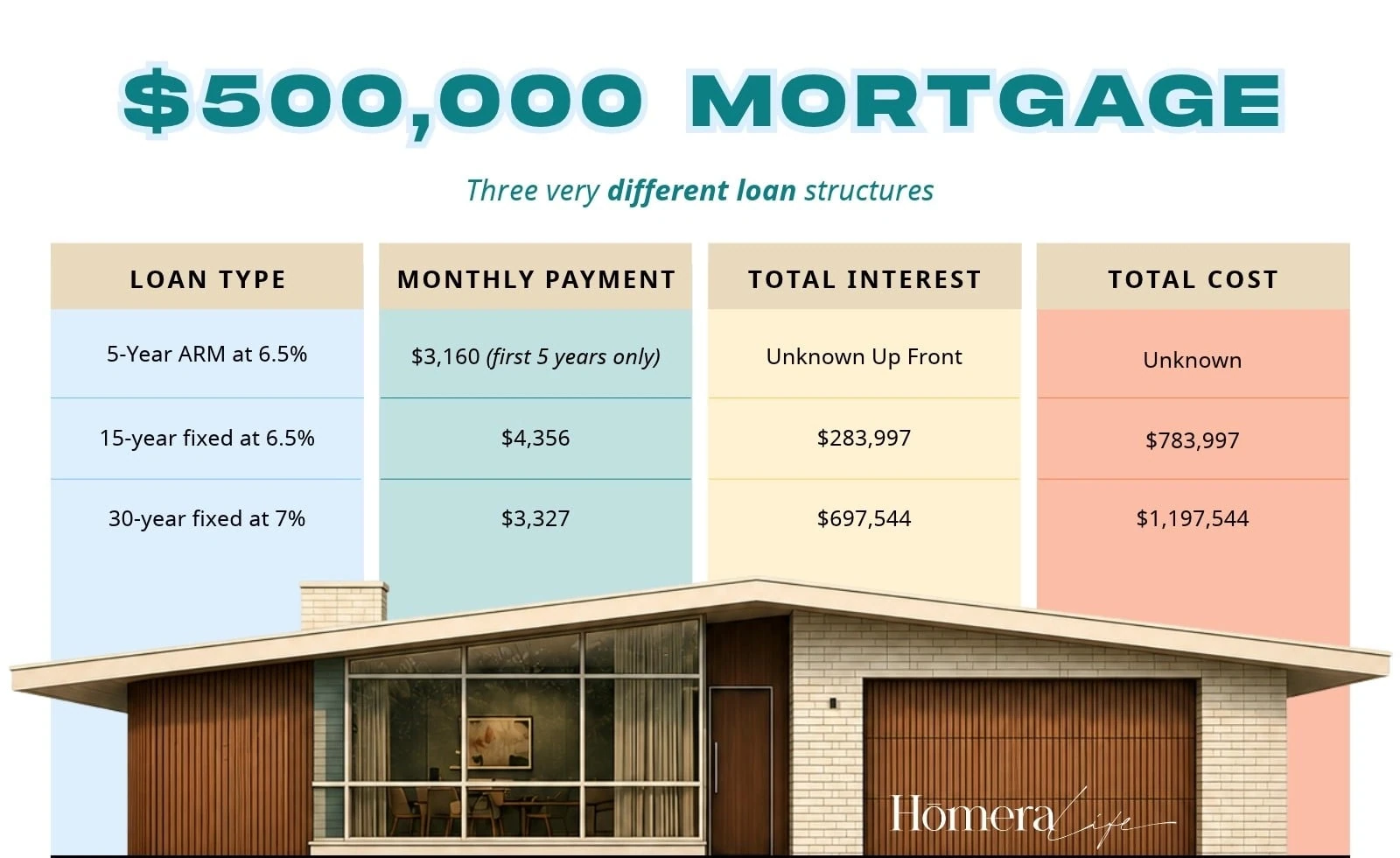
The loan was a 5/1 adjustable-rate mortgage. A structure where the rate starts lower and adjusts with the market after a fixed period. For someone planning to sell within three to five years, this can make sense, but my friend planned to stay for over a decade.
I told him what that structure actually meant for his life over ten years. He walked away from it. Not because the payment was unaffordable, but because the structure was wrong for his life. Adjustable-rate mortgages transfer rate risk from the bank to the borrower. If rates climb after year five, his payment adjusts upward with no ceiling on how high it can go. The lender’s protected from uncertainty, not him.
The monthly difference between his adjustable-rate loan and a 30-year fixed loan was just $134. That’s what made it feel like a deal. However, in exchange for saving $134 a month, he was taking on the risk of much higher payments after five years. A tradeoff he hadn’t fully understood because no one had explained it to him that way.
The warmth was real. The misalignment was also real. Both things can be true at the same time.
What Disappears When the Focus Stays on the Monthly Number
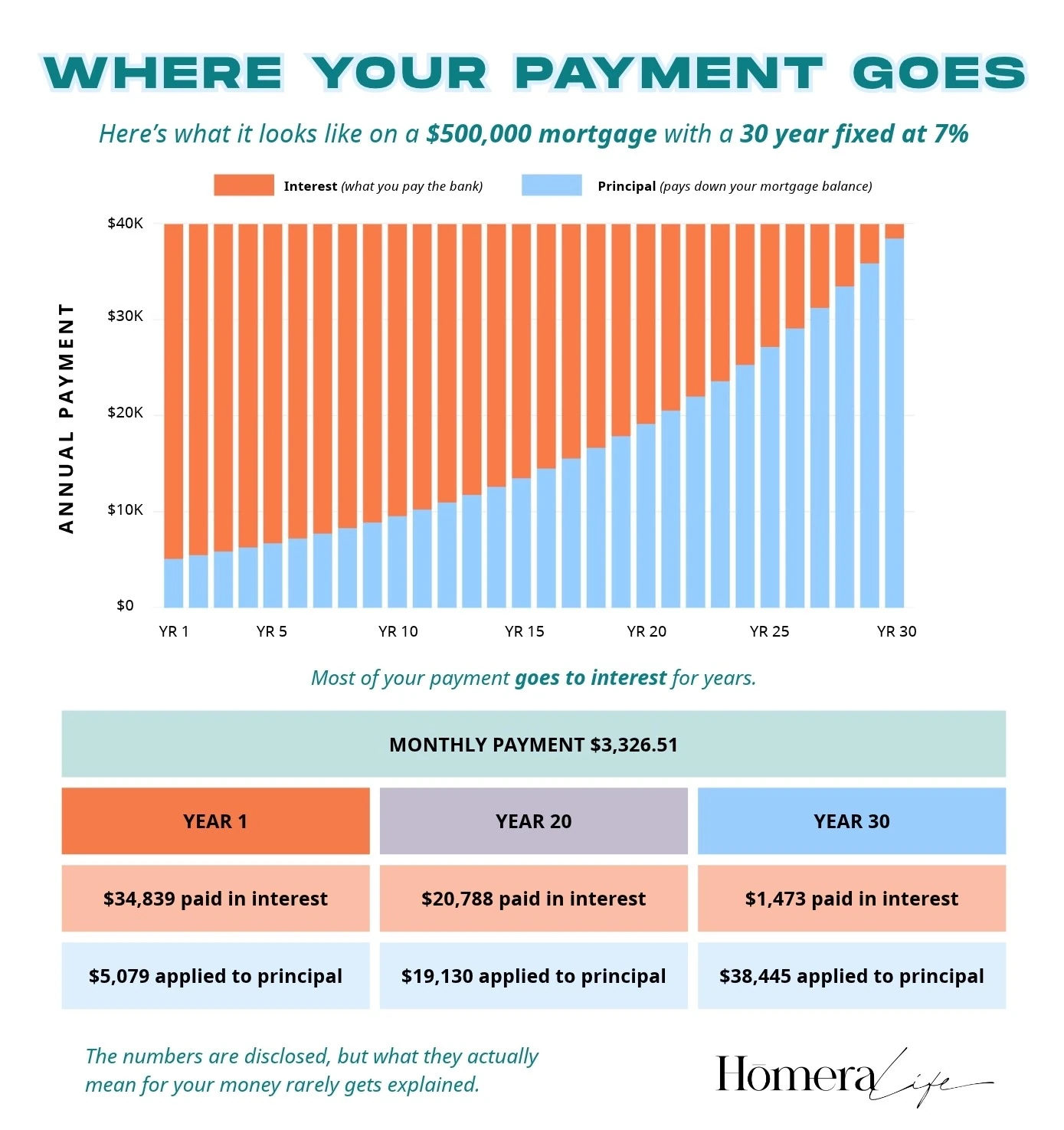
On a $500,000 loan at 7%, your first monthly payment is roughly $3,327. Of that, approximately $2,917 goes to the bank as interest. Around $410 goes toward the principal you actually own.
That number is not hidden. It’s in the paperwork. What is hidden is how it’s framed. No one selling you your loan will say “In your first year, you’ll make twelve payments totaling nearly $40,000, and you’ll own approximately $5,000 more of your home than when you started.” The math is there, but the context is not.
That doesn’t mean the lender did anything wrong. It’s what happens when a system optimizes for approval and the borrower mistakes that approval for reassurance that they’re making the right choice.
There’s also something almost no one discusses. Personal finance is private. Your home price, your rate, your loan structure, these aren’t things you compare with friends over dinner.
Nobody calls a colleague to ask whether their debt-to-income ratio sounds right. So when the lender presents a structure, there is no reference point. No peer sanity check. No one in your life you can ask: is this normal, is this a good deal, does this structure make sense for someone in my situation?
You’re navigating one of the largest financial decisions of your life in near-complete isolation, with only the word of someone who gets paid when you sign.
What Understanding the System Actually Changes
Knowing how the incentives work doesn’t make you suspicious of everyone at the table. It makes you a more precise evaluator of what you’re being shown.
My aunt has a phrase she uses when we’re working through a case: follow the structure, not the person. The individual broker or loan officer may be entirely well-intentioned. What matters is whether the structure they’re presenting serves your life over the period you’ll actually hold it. That’s the question the system wasn’t built to answer for you. It’s the question you have to ask yourself.
Before agreeing to any mortgage, there are three things you should fully understand. My aunt and I have reviewed thousands of cases where borrowers moved forward without a clear understanding of one or more of them.
A landscaping contract is still a contract. Treat it like one.
1. How does this loan behave over the period you actually plan to hold it?
Don’t just consider the best-case scenario. Think about what happens if your income changes, your family circumstances change, or you need to sell your home sooner than expected. In many of the cases my aunt and I reviewed, homeowners ran into financial trouble because the terms of their mortgage didn’t fit how long they actually stayed in the home. The potential problems were there in the original loan documents, but no one had discussed what could happen if their plans changed.
2. What tradeoffs are built into this structure, and who benefits from them?
The difference between a 30-year and a 15-year fixed is more than $400,000 in total interest on a $500,000 loan. That tradeoff exists in every loan conversation, and it rarely comes up unless the borrower asks. Some tradeoffs benefit you. Some benefit the lender. Over the years, my aunt and I have seen how certain loan terms can create serious financial problems down the road. Understanding which terms work in your favor and which could cost you later on isn’t an over abundance of caution, it’s simply understanding what you’re agreeing to before you sign.
3. What assumptions is this structure making about your future?
Every loan comes with assumptions about what your life will look like five, ten, or fifteen years from now. Most borrowers don’t realize just how much they’re counting on those assumptions coming true. When they don’t ask they’re gambling with their future. In our work, the cases that required the most intervention were almost never the result of bad luck. They happened because the loan was built around expectations and structure that was fine at signing but catastrophic when real life happened.
If you don’t fully understand these three things, you’re not seeing the entire picture. It’s not because you haven’t done your homework, it’s because the system was designed to answer a different question than the one that actually matters.
What the Mortgage Doesn’t Stop Doing After You Sign
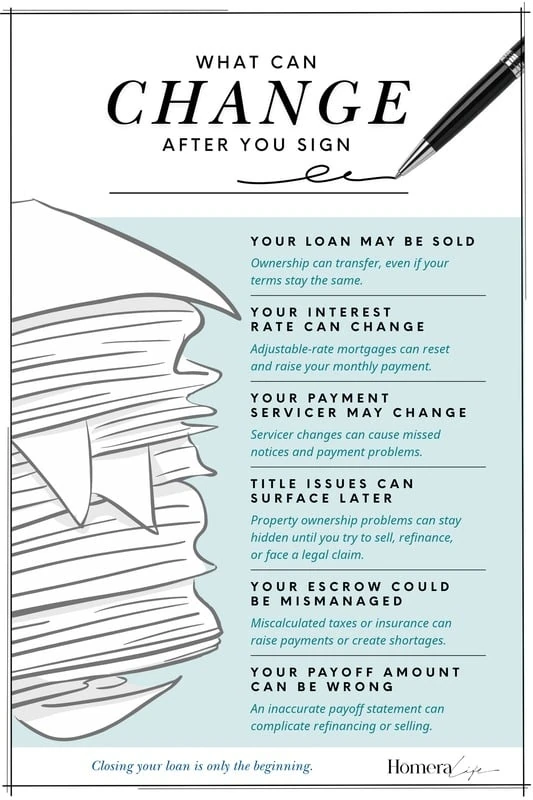
Choosing the right structure is only the first part. What happens after closing is a separate system entirely, and almost nobody warns you that it exists.
The loan you close on continues moving through the system long after you stop thinking about it.
Your loan may be sold, and the company that collects your payments may change, possibly multiple times. Your escrow account will be managed by people who’ve never spoken to you. Your tax disbursements can be miscalculated. Your chain of title can develop gaps you won't discover until you try to sell, refinance, or face a legal challenge.
The document you signed at the closing table is only the beginning of a long relationship with a system that keeps operating around you, largely out of view.
This isn’t a reason not to buy a home. It’s a reason to understand what you’re signing before you sign it, and to keep paying attention well after.
The cases that brought people to my aunt’s door were rarely the result of a single bad decision. They were the result of a system operating unchecked for years while the homeowner assumed everything was fine.
If you know someone navigating a mortgage right now, pass this to them. They deserve to see what they’re stepping into.