
I’ve built a career on one decision: what to handle myself versus what to pay someone else to do. For most of my life, particularly when it came to my home, that answer never changed. Someone else can do it.
I’ve sat across the table from people selling companies and always found the problems others skimmed past. But when it came to my own home, I had no idea where the air filter was. Another reason why I rented, to never have to know. I was single and I traveled so much that it got to the point where I never fully unpacked my suitcase. Home was a place thousands of miles away that I visited a few times a year.
Buying a place wasn’t even a question. For me, the numbers didn’t add up. I never stayed anywhere for more than a few years, and when you’re in that situation the rent-versus-buying equation falls hard toward renting. So I rented, and treated it like any other deal.
Now keep in mind, I was not a casual tenant. Before I signed a lease I read the reviews, hundreds of them, hunting for the one number that never makes the listing: how fast management fixes what breaks. I paid a premium for the buildings that passed. When the dishwasher quit, or the disposal seized, or a brown ring bloomed on the ceiling from the unit above, I made one call and it became someone else's afternoon.
What I Was Really Paying For
Renting was a luxury, though I wouldn't have used that word then. Saturdays never disappeared into a hardware store and weeknights never ended under a sink. Although I wasn’t building equity, I didn’t mind because I wasn’t the one lying awake listening to a water heater make a sound it shouldn’t make.

I wasn’t paying extra for a nicer apartment. It was paying to never worry about what broke or how to fix it.
A tactic that worked perfectly, until it didn't.
Then life changed, all at once. Married, two dogs, a baby on the way. It was the first time I didn’t want to move. After years of living out of a suitcase, in cities that were never home, all I wanted was to be near my parents while raising my family. To stay in one place for a decade or more.
The equation that had been "rent" for years instantly flipped to "buy," because I was finally buying the thing renting could never give me: permanence. The problem was, I underpriced everything that came with the keys.
My husband loves home projects. His superpower is that he can fix almost anything, which he loves doing on the weekends just for fun. House-related work was mostly his, which left me in blissful ignorance. Which is funny, because I wasn’t raised to be the woman who can't do something. My dad taught me to change my own oil and my tires before he let me drive off alone, just so I'd never have to depend on anyone for anything that simple.
For years that worked. Then came the years on the road and the marriage to a man who loves to fix things, and somewhere in between I handed all of the simple things back to my husband. I had become exactly what my father raised me not to be, and I never even noticed it happening.
What I hadn’t realized was that a house where only one person knows how anything works is a fragile house.
A running toilet doesn’t wait for your husband to get home. So, I had to relearn the basics, not to prove a point or to take the wrench from his hands, but so that if I was the only one home when something broke, I wouldn’t be stranded at the mercy of a technician’s calendar.
The Night the Air Died
The first night he was gone was when I really learned how much that mattered.
He was three states away visiting his family. I was very pregnant, so I stayed home to focus on a few important tasks: binging the shows he couldn’t stand and having nowhere to be. It was early summer with the kind of heat that arrives a month before anyone’s ready for it. An hour into my binge, the house began to feel wrong. I put my hand to the nearest vent and the air limping out of it was barely moving. What did move wasn’t cold. The unit was running, but the house was getting warmer.
I was hot, large, and not at my most rational, so my first instinct while standing in front of a machine I didn't understand was to pick up the phone and pay my way out of it. I called an HVAC company. The soonest they could come was in seven short days, and they wanted three hundred dollars just to diagnose the problem. Seven days and three hundred dollars. In my situation that was not an option.
For a minute I sat down in front of the dead vent and let myself feel it, hot, pregnant, alone, and at the mercy of a schedule that I couldn’t control. I didn’t like it. There was no way I was going to survive a week like that.
So I called my husband. He answered during dinner and tried his best to point me in the right direction as his family watched. “Check the filter,” he said, “Make sure air is moving.” Those two sentences were all I needed to start diagnosing the problem myself.
I Googled: AC running but not blowing cold, and why is my AC blowing warm air. The one answer I never thought to ask the service line came back in the first thirty seconds: rule out the cheapest, most common cause first, a dirty filter.
A filter? I didn’t even know where mine was. Another Google search: Where is my home air filter? It led me to a video with the answer: look in the attic for a big metal cabinet that has a slot clearly labeled “filter.”

Bingo! Now I knew what to look for. I watched a second video, which told me that if the air was weak and warm but the unit was still running, I would have to trace the refrigerant line back to see if there was frost on it. If I found it, that usually meant one thing: not enough air was getting through.
I found the frost thick and icy. Then, I pulled the filter out from the slot labeled “filter” on my unit. It was thick with dirt and impossible to see through. I dropped in a clean one, switched the system off so the ice could melt, and once it had, I turned it back on. Within the hour, the air came back cold and strong.
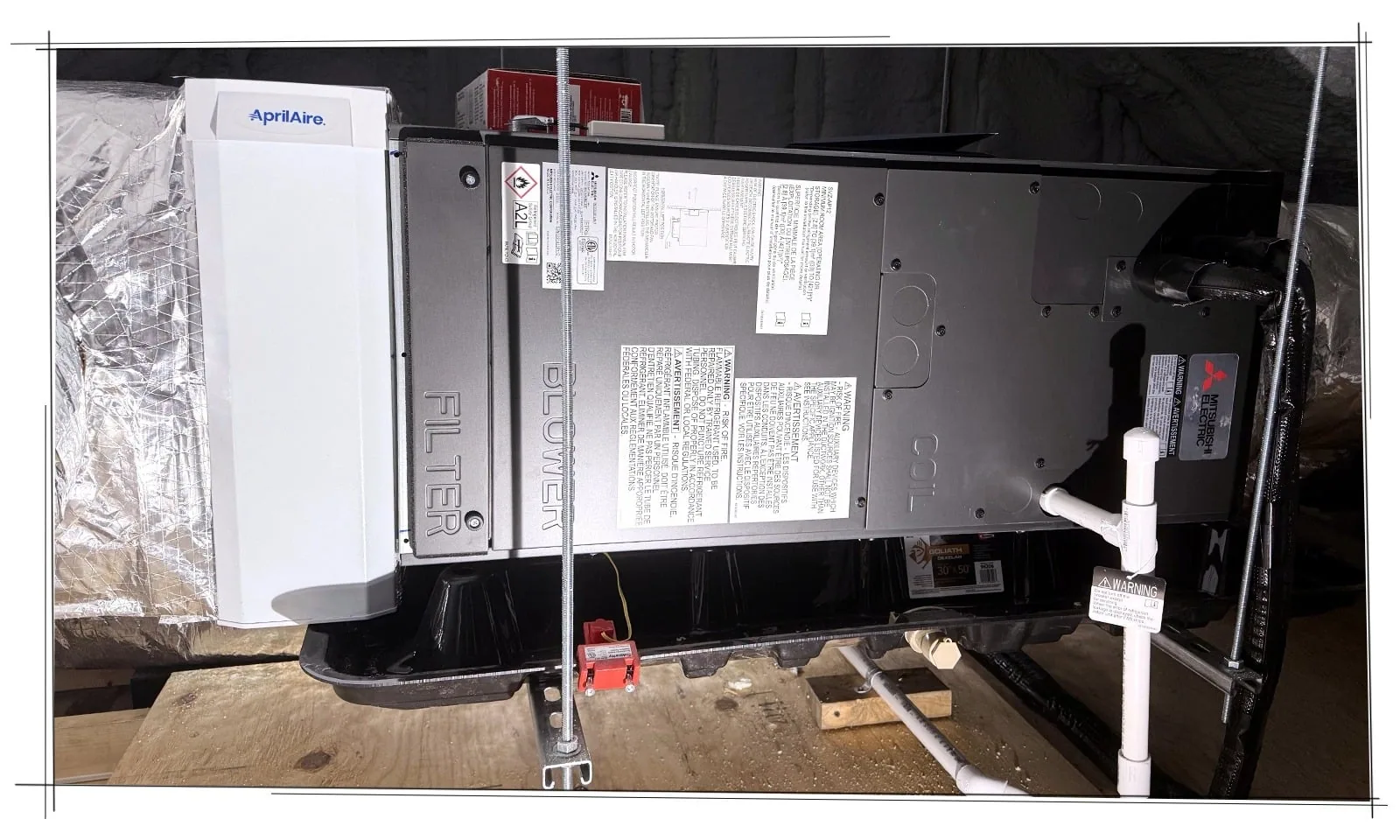
All it took was a ten-dollar filter, two YouTube videos, and five minutes of work. Had I waited a week, the technician would have done the exact same thing for three hundred dollars.
The house came back to sixty-eight degrees, the only temperature a very pregnant woman in that heat could tolerate. I stood in front of the vent and exhaled for a very long time and smiled.
Then, barely able to move at that stage, I went back to what I’d been doing before any of it. I parked myself on the couch with a tub of ice cream and binged White Lotus.
Call It, or Do It
That night taught me one idea that the whole house now runs on.
An air conditioner isn’t a "call someone" or a "do it yourself" problem. It’s both, depending on what’s wrong with it. A clogged filter is something I can fix; all it takes is ten dollars and about twenty minutes, most of it spent figuring out where the filter is. A failing compressor or a refrigerant leak should be done by an expert: licensed, costly, nothing I should touch. Same unit, two different answers. The skill was never learning to fix an air conditioner. It was learning to better diagnose the problem before deciding how to solve it.
That’s the question for everything that breaks:
What happens if I get it wrong?
If the worst case is a wasted ten minutes, I handle it. If the worst case is a flood, an electric shock, a fire, or a four-figure repair, it’s worth the wait and the call. Most of what breaks in a house is relatively easy to solve, but there’s an entire service economy built around fixing things most homeowners never learned to fix themselves.
The information was never the hard part. A few minutes of searching will tell you what’s wrong. The hard part is looking before you dial.
Across a year, the handful of jobs I now handle myself include filters, a running toilet, a slow drain, and a jammed disposal. Things that would run well past a thousand dollars if hired out, mostly due to the fee for someone to show up. All of which are solvable for less than two hundred dollars in parts.
Yes, I still call experts, and not only for the dangerous things. Sometimes the problem could be any one of ten things, and for a mother running a company on little to no sleep, paying someone to carry that isn’t lazy; it’s triage. I own the basics.
What It Gave Me
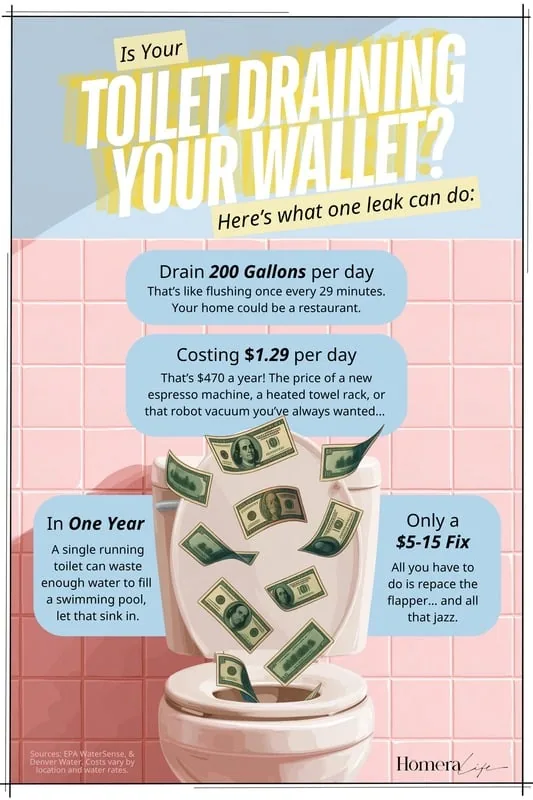
A while later, with a newborn in the house, I heard a toilet running. My son had just gone down, and he loved to sleep, which gave me a rare minute to myself. I had no intention of spending it on hold with a plumber. My husband was home, and he would have been happy to fix it, but something in me balked at waiting for him to handle every broken thing in the house. I had a minute, and I was standing right there.
I did the math on the amount of water a running toilet wastes, which by the way, can be as much as 200 gallons a day. So I Googled it again, watched a video, and swapped the flapper in less than five minutes. I felt calm, empowered, and a little too proud of something that was never that hard. I bragged about it to my husband the second I saw him, like I had just done brain surgery.
For years I thought luxury was making every problem someone else's. The better one, it turns out, is standing in my own house, knowing which problems were mine to handle and which are worth the call.
This is the list I use to decide who picks up the wrench: me or a pro. The jobs worth doing yourself are the simple with a small downside if you get it wrong. The ones worth a phone call are the mistakes that could flood the house, shock you, start a fire, or cost you four figures. Download it free with your subscription. Not a subscriber yet? This is your reason to join.