
I was a CFO.
I’ve built the financial models that steered billion-dollar companies. At 22, I turned down free money every month, on purpose, without quite understanding that was what I was doing.
My first real job came with a 401(k) match. I put in a little and the company added money on top, for no extra cost, just for taking part. I had about $200 left at the end of each month after rent and bills, but I didn’t put it in. I spent it. Bars on the weekend, a cute top for nights out, and those small, forgettable pleasures of being 22 in a city. The $200 felt like mine to enjoy, so I enjoyed it.
Here’s what that $200 was worth.
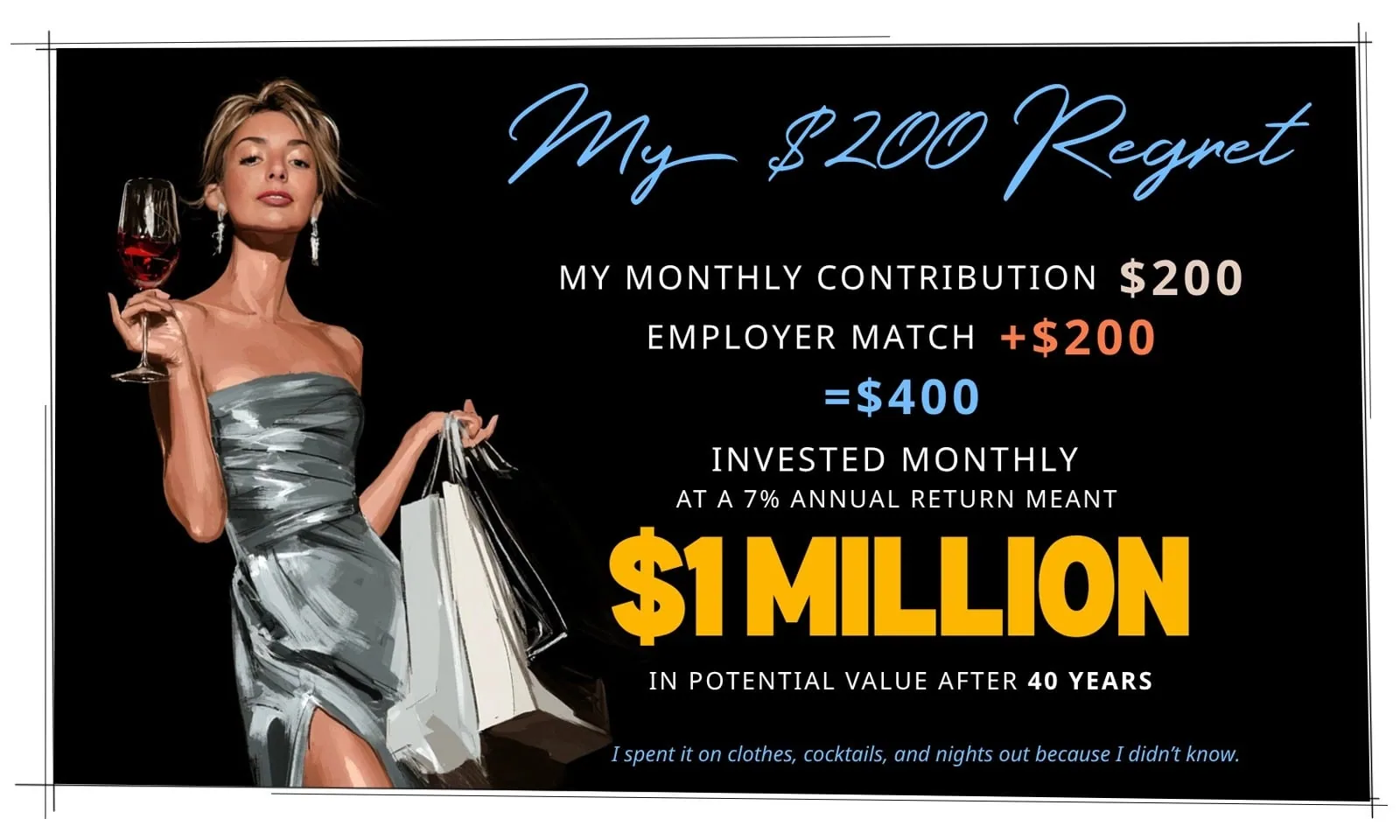
Matched to $400 a month and left alone at ordinary market returns, it grows past a million dollars over a career. The match alone, the free half I waved off, was worth more than half a million by itself, and that’s without a single raise. And I spent it on clothes I no longer own.
That opt-in form didn’t look like the most important financial decision of my year. It looked like paperwork. Which was the problem.
The thing that should have mattered the most was disguised as something that mattered the least, and I had no way to tell the difference.
This isn’t a story about being bad with money. I was trained in it. I went on to do it for a living. I understood compounding better than almost anyone I knew. And none of that training reached the part of my brain making a $200 decision at the end of the month. Being good with money in one place doesn’t make you good with it in others. I could model a corporate balance sheet in my sleep and still miss the easiest win in my personal finances.
I learned that the hard way, a few years later, in a café in Budapest.
Three Grand and Six Time Zones
I was 26 and living there on assignment. I used to sit with a coffee in the mornings and think about how improbable it was. A girl from Cape Cod, in Hungary, seeing things her younger self could never have imagined. It really was remarkable.
One of those mornings, I opened an email from headquarters about something called tax equalization. I read it twice. As best I could tell, it said I owed thousands of dollars in Massachusetts taxes on money I’d earned while sitting in Budapest. All because of a calculation that had gone wrong somewhere I couldn't see.

I didn’t know what the words meant. I knew what the number meant.
Three thousand dollars, to a 26-year-old, wasn’t an inconvenience. It was a crisis. My parents couldn't help. They didn't have it. There was no one to call who would understand it for me.
And I couldn't tell how bad it was. That was its own kind of helplessness, not knowing whether this was a real emergency or a clerical one, whether the number was a mistake to be fixed or a bill I simply owed. I didn't know what deserved my panic and what deserved a shrug.
So I sorted it out myself. Alone, in November, six time zones away from anyone who loved me. By the time it was done, I couldn't afford the flight home, so I spent that Thanksgiving in Budapest, away from my family, over a financial document I hadn't been able to read.
That November I made myself a promise. I would never again be completely lost inside something as important as my own money.
Keeping it was harder than I expected. Every corner of personal finance has its own language. Escrow. Amortization. Points. Recast. Fully indexed rate. None of it is intuitive, and most of it gets explained, if it gets explained at all, by someone whose job it is to get the paperwork signed, not to make sure you understood it.
So most of us do the reasonable thing. We avoid it. A small dread arrives with the statement or the loan packet, and we set it aside. We just trust the professional across the table to have it handled. That’s not laziness. It’s what anyone does when something feels intimidating and a little shameful to admit you don't understand. I know, because I did it with a 401(k) form that would have taken ten minutes to complete had I understood.
You Don't Need to Know Everything. Just What Matters.
Then I made the decision to learn it, deliberately, the way you study for something that matters.
I confess, it wasn’t easy. Anyone who says personal finance is simple is selling you something. It’s not simple. It’s vast and technical, and there’s always another layer, and I’ve never met a single person, including people who do it for a living, who understands all of it.
But here’s what I did learn, and it’s the thing that changed everything. You don’t need to understand it all. Much of it doesn’t matter most of the time, and a small part of it matters enormously. The skill was never knowing everything. It was knowing what to look at, and no one teaches that.
The people who navigate this well aren’t the ones who learned the most. They’re the ones who learned what to ignore. That’s a far smaller thing to conquer than the whole field, and it’s learnable, even when the field as a whole isn’t.
The problem is that no one hands you that filter. The system gives you everything at once. Hundreds of pages of disclosure, every term weighted the same, the five lines that will cost you buried among the hundreds that never will. I’ve read those pages. Professionally. They’re built to satisfy legal requirements, not to be understood. Handing you all of it, undifferentiated, is the same as handing you none of it.
What you needed was never the whole library. It was someone to tell you which shelf to stand in front of.

Here’s what that looks like.
When you purchase a home, the closing package can run well over a hundred pages. At least three business days before closing, you’ll receive a five-page document called the Closing Disclosure.
On the first page is a box called Loan Terms. Next to your loan amount, interest rate, and monthly payment, it answers one question: Can this amount increase after closing?
Just below, it tells you whether your loan has a prepayment penalty, meaning a fee for paying it off early, or a balloon payment, meaning one large lump sum due at the end. Each answer is a simple YES or NO. If you see a YES anywhere in that box, that’s what you ask about first.
I didn’t come to this from nowhere. Early in my career, I worked beside my aunt, a forensic mortgage analyst. I watched her untangle some of the most detailed and complicated financial documents you could imagine to really understand what mortgages had done to families who came to her as a last resort. Even with that front-row seat and a finance degree, I still had to sit down and study how my own money worked.
If it took me, with the training, the aunt, and the years of proximity, deliberate effort to learn what mattered, no one was ever going to know it by instinct.
The One Person Nobody Prepared
Which means the not-knowing was never a personal failing. Here’s the uncomfortable truth underneath it: teaching us this is no one's job. Not the schools we went to, where the French Revolution made the syllabus and the escrow account did not. Not the bank's, whose job is to hold your money, not explain it. Not the lender’s, whose job ends the day the loan closes. Not the broker's or the servicer's. Not even the closing attorney's, who in many cases represent the lender, not you.
Every one of them has a defined role, and not one of those roles includes making sure you understand what you signed. The responsibility was never handed to anyone. So it lands on the one person who was never trained for it.
You’re the only party to the transaction whose job is to understand the transaction.
The standard advice, "educate yourself,” or “do your research," assumes a library that doesn’t exist. The disclosures are complete and unreadable. The blogs are pitched so simply they say nothing anyone can act on. The industry's own explainers stop exactly where the useful part begins. Every source holds a piece. None holds the whole. Assembling a real understanding out of that isn’t an afternoon of research.
It’s a second job, and no one told us we had been hired.
It’s not a conspiracy. It’s arithmetic. A person signs a mortgage a few times in a life, enrolls in a retirement plan once or twice, buys an insurance policy and doesn’t look at it again for a decade. The people on the other side of those transactions do it every day. They know where the costs hide and which terms matter, because it’s their profession and it will never be ours. All the experience in the room sits on one side of the table.
The Cost of What You Don't Know
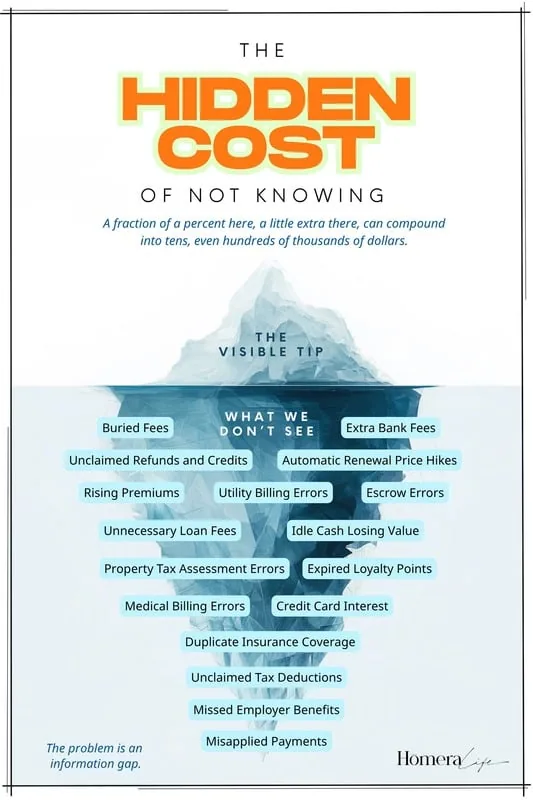
The harm, when it comes, is usually invisible to the person it happens to.
A fee buried inside a retirement fund, a fraction of a percent a year. A premium that renews a little higher every year. An escrow miscalculated. A payment applied to the wrong place. These are small things that repeat, and the person paying for it rarely finds out.
We can’t catch what we were never taught to see.
Most of us turn it into shame. Not smart enough. Not disciplined enough. Not the kind of person who has it together. I did it for years, embarrassed that someone who ran numbers for a living had been so careless with her own.
It was never a character flaw. It was an information gap, and it was never ours to close alone. The problem was never intelligence. What mattered looked exactly like what didn’t.
The sense that something important is sitting just out of view isn’t a failure of attention. It’s accurate.
That’s what this magazine is for. Not to teach you everything. Most of it will never matter. It’s here to show you, one system at a time, which parts move real money and which parts you can safely set aside. None of us were going to learn all of it. We were never meant to.
It’s what I spent two hard lessons wishing someone had done for me.
If this resonated, forward it to someone who’s still setting the paperwork aside. You deserve to see what you’re stepping into.